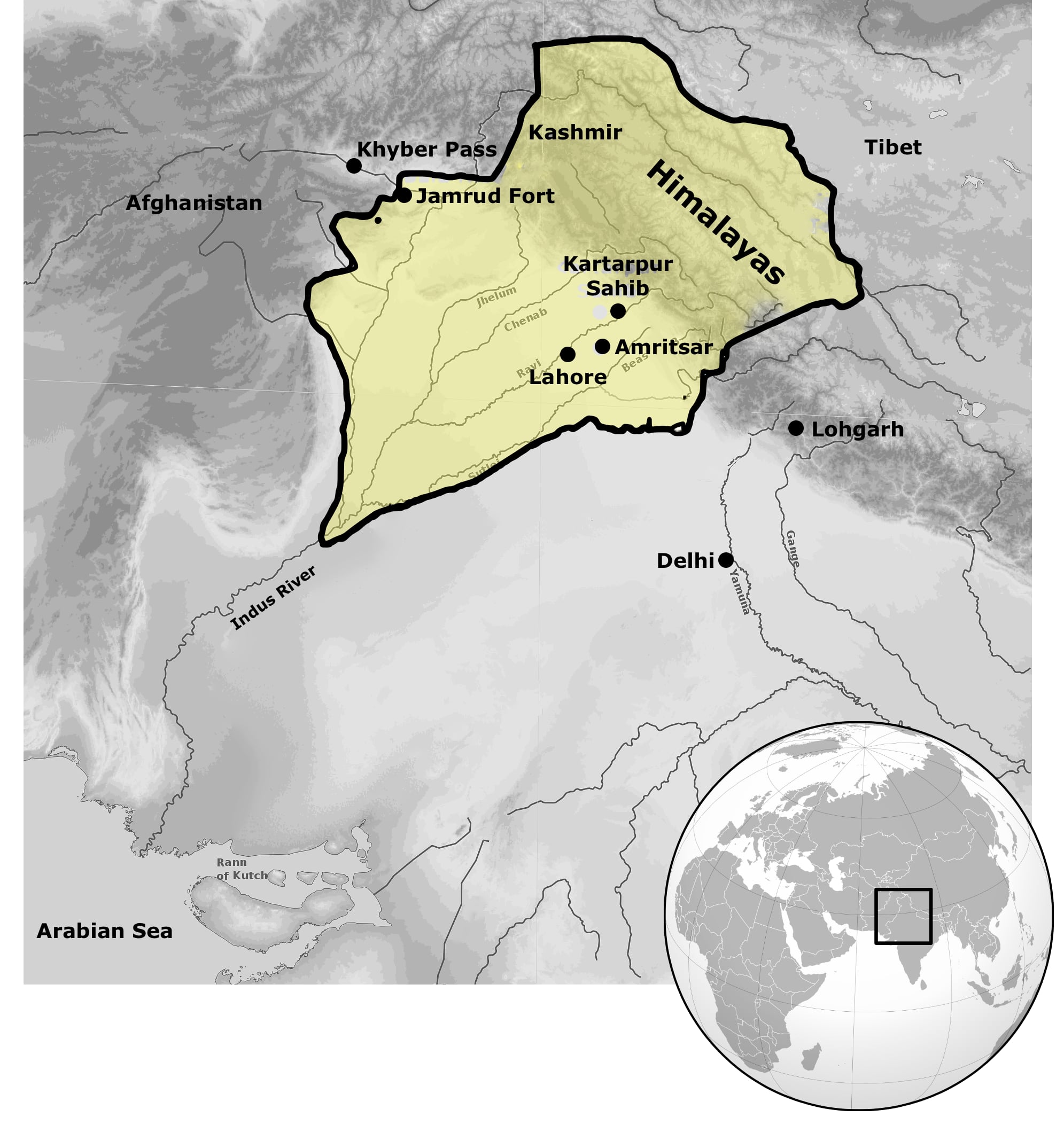
It stretched from the geopolitically strategic Khyber Pass in present day Pakistan, to Punjab. In the North, it included most of present-day Kashmir.
Its main achievements were:
Cosmopolitan nature: people from various backgrounds, religions, and origins served in the government. This included European Generals in the army. Maharaja Ranjit Singh is equally credited and praised as well as criticized for secular-decision making after consultation with Sikh and non-Sikh advisors. The role of Sikh religious institutions was reduced. This was necessary as Sikhs were only 12% of the population in the Kingdom, and several experts required for governance were from other backgrounds.
Meritocracy: 'Maharaja had a valuable gift of selecting the right man for each post and in utilising the services of all those who had talent irrespective of their nationality and community.' (Prof. Ganda Singh and Prof. Teja Singh, 'Maharaja Ranjit Singh', p. 223).
Federalism: there was devolution of power to provinces.
Public Safety, crime, punishments and imprisonment: "Fines were the chief form of punishment. Imprisonment was unknown and capital punishments were rare except in the north-west frontier districts of Peshawar and Hazara. Crime decreased remarkably and 'on the testimony of [Barron Charles] Hugel we can assert that the Punjab was even safer than Hindustan, then under British Sovereignty'." (Prof. Ganda Singh and Prof. Teja Singh, 'Maharaja Ranjit Singh', p. 225).
Enabling environment for commerce: 'Trade and Commerce was promoted by Maharaja Ranjit Singh. With attention paid to growth of cities and towns, the enabling environment for the craftsmen, traders, manufacturers and merchants was provided so that they could flourish and grow.' (Gurdeep Kaur, 2019)
Military achievements: 'For about eight centuries, India had been the hunting ground of foreign invaders from the north-west who carried away year after year the children of this country to be sold in the bazaars of Ghazni and Kandhar. This conquest of Maharaja Ranjit Singh damned the current of north-western invasions and drove the erstwhile invincible Afghans back into their mountain defiles, but it rather turned the tide of conquests from east to west'a thing so far unknown to the history of India, and an achievement for which he deserves the greatest credit from his countrymen.' (Prof. Ganda Singh and Prof. Teja Singh, 'Maharaja Ranjit Singh', p. 34).
Barron Charles Hugel was a European traveler who visited South Asia during the time of Maharaja Ranjit Singh. He wrote "Never perhaps was so large an empire founded by one man with so little criminality; ; and when we consider the country and the uncivilized people with whom he has had to deal, his mild and prudent government must be regarded with feelings of astonishment." (Barron Charles Hugel, 'Travels in Kashmir and Punjab', p. 382). Meritocracy: 'Maharaja had a valuable gift of selecting the right man for each post and in utilising the services of all those who had talent irrespective of their nationality and community.' (Prof. Ganda Singh and Prof. Teja Singh, 'Maharaja Ranjit Singh', p. 223).
Federalism: there was devolution of power to provinces.
Public Safety, crime, punishments and imprisonment: "Fines were the chief form of punishment. Imprisonment was unknown and capital punishments were rare except in the north-west frontier districts of Peshawar and Hazara. Crime decreased remarkably and 'on the testimony of [Barron Charles] Hugel we can assert that the Punjab was even safer than Hindustan, then under British Sovereignty'." (Prof. Ganda Singh and Prof. Teja Singh, 'Maharaja Ranjit Singh', p. 225).
Enabling environment for commerce: 'Trade and Commerce was promoted by Maharaja Ranjit Singh. With attention paid to growth of cities and towns, the enabling environment for the craftsmen, traders, manufacturers and merchants was provided so that they could flourish and grow.' (Gurdeep Kaur, 2019)
Military achievements: 'For about eight centuries, India had been the hunting ground of foreign invaders from the north-west who carried away year after year the children of this country to be sold in the bazaars of Ghazni and Kandhar. This conquest of Maharaja Ranjit Singh damned the current of north-western invasions and drove the erstwhile invincible Afghans back into their mountain defiles, but it rather turned the tide of conquests from east to west'a thing so far unknown to the history of India, and an achievement for which he deserves the greatest credit from his countrymen.' (Prof. Ganda Singh and Prof. Teja Singh, 'Maharaja Ranjit Singh', p. 34).
Why did Sikh Kingdom fall after 50 years? It was due to traitors in its midst as well as several other factors. "The rise and fall of the Sikh Empire was never really a self- contained or isolated affair. We cannot overlook the fact that its story is embedded in the wider world of the nineteenth century, a time when the powers and privileges of royal elites across the globe were subject to great challenge and change." (Dr. Priya Atwal, 'Royals and Rebels: the Rise and Fall of the Sikh Empire', p. 209).
"The recorded history finds no parallel for his remarkable military genius, able administrator ship and astute statesmanship." (Dr. Gurdeep Kaur, Good Governance by Maharaja Ranjit Singh, 2019). (Gurdeep Kaur, 2019)
Maharaja Ranjit Singh was selected as the 'Greatest Ruler in History' by a poll of Historians by BBC History. (BBC History, 2020)
"Maharaja Ranjit Singh with his distinctive qualities has his name written in golden letters in the pages of world history." (Gurdeep Kaur, 2019)